
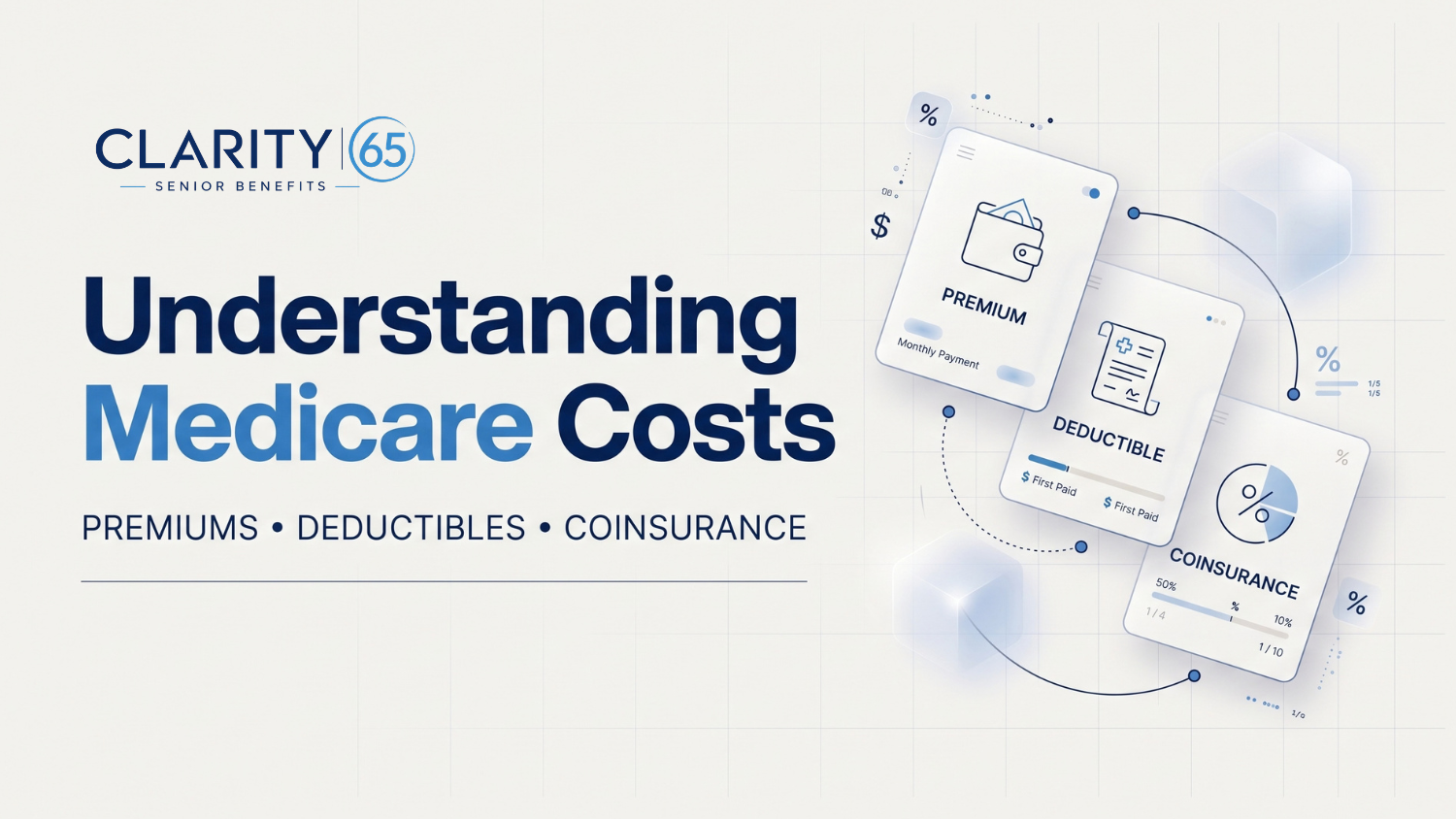
Medicare costs can be confusing because there is rarely just one number to look at.
You may see a monthly premium, an annual deductible, a copayment, coinsurance, and an out-of-pocket limit. Then there are different rules for Part A, Part B, Medicare Advantage, Part D, and Medicare Supplement Insurance.
Understanding Medicare costs starts with knowing what each term means and when you may have to pay it.
For 2026, the standard Medicare Part B premium is $202.90 per month, and the Part B annual deductible is $283. Part A has different cost-sharing rules, while Medicare Advantage and Part D costs vary by plan.
The goal is not to memorize every dollar amount. It is to understand how the pieces fit together so you can ask better questions when reviewing coverage.
In This Guide:
- AI Overview: How Do Medicare Costs Work?
- TL;DR: Medicare Costs at a Glance
- What Is a Medicare Premium?
- What Is a Medicare Deductible?
- Understanding the Part A Deductible
- Understanding the Part B Deductible
- Medicare Advantage Deductibles
- Part D Drug Deductibles
- What Is Medicare Coinsurance?
- Coinsurance vs. Copayment
- How Medicare Costs Work With Original Medicare
- How Medicare Advantage Costs Work
- How Part D Costs Work
- Where Medicare Supplement Insurance Fits In
- A $0 Premium Does Not Mean $0 Healthcare Costs
- What Should You Look at When Reviewing Medicare Costs?
- What Can Make Medicare Costs Higher?
- How to Estimate Your Potential Medicare Spending
- Can You Get Help Paying Medicare Costs?
- A Simple Medicare Cost Checklist
- How Clarity65 Can Help You Review Medicare Costs
- Final Thoughts
- Frequently Asked Questions
AI Overview: How Do Medicare Costs Work?
Medicare uses several forms of cost-sharing.
A premium is the amount you pay to have coverage, usually each month. A deductible is what you pay for covered services or prescriptions before the plan begins paying according to its rules. Coinsurance is generally a percentage of the cost you pay after meeting a deductible. A copayment is usually a fixed amount.
The amount you pay depends on the type of Medicare coverage you have.
With Original Medicare, Part A and Part B have different deductibles and cost-sharing rules. Medicare Advantage plans set their own covered-service cost-sharing within Medicare's rules and have a yearly out-of-pocket limit for covered Part A and Part B services. Part D plans have their own premiums and prescription drug cost-sharing.
TL;DR: Medicare Costs at a Glance
| Cost | What it means | Example |
|---|---|---|
| Premium | Amount you pay for coverage | Part B has a standard monthly premium |
| Deductible | Amount you pay before coverage begins paying under the applicable rules | Part B deductible applies each year |
| Coinsurance | Percentage of a covered cost you pay | Part B generally has 20% coinsurance after the deductible |
| Copayment | Fixed amount you pay for a covered service or prescription | A plan may charge a set dollar amount |
| Out-of-pocket limit | Maximum you pay for certain covered services under a plan during the year | Medicare Advantage plans have a yearly limit for covered Part A and Part B services |
The important point is that these costs do not all work the same way across Medicare.
What Is a Medicare Premium?
A premium is the amount you pay for your Medicare coverage.
Think of it as the cost of having the coverage in place, rather than a bill tied to a specific doctor visit or prescription.
Different parts of Medicare have different premium rules.
Part A Premium
Most people do not pay a monthly premium for Medicare Part A because they or a spouse paid Medicare taxes long enough to qualify for premium-free Part A.
CMS says approximately 99% of Medicare beneficiaries do not pay a Part A premium. In 2026, people who have to buy Part A can pay either $311 or $565 per month depending on their work history.
Part B Premium
Part B generally has a monthly premium.
The standard Part B premium is $202.90 per month in 2026. People with higher incomes may pay an additional amount called an Income-Related Monthly Adjustment Amount, or IRMAA.
That means two people with Part B can have different monthly premiums even though they have the same Medicare coverage.
Part D Premium
Part D premiums are set by individual Medicare drug plans and can vary. People with higher incomes may also pay an additional income-related amount.
A low monthly premium does not necessarily mean a plan will have the lowest overall costs for your prescriptions. Drug deductibles, formularies, pharmacy networks, and cost-sharing also matter.
Medicare Advantage Premiums
Medicare Advantage plans set their own premiums and other cost-sharing within Medicare's rules.
Some plans have a $0 plan premium, but that does not mean you pay nothing for Medicare. You generally still have to pay your Part B premium to remain enrolled in Medicare Advantage. Some plans may help pay all or part of the Part B premium.
Medigap Premiums
Medicare Supplement Insurance, or Medigap, has a separate premium.
Medicare says Medigap premiums vary based on the policy, insurance company, where you live, and other factors. You must have Part B and continue paying the Part B premium to keep a Medigap policy.
What Is a Medicare Deductible?
A deductible is the amount you pay for covered healthcare or prescriptions before the coverage begins paying under the applicable rules.
But Medicare does not have one single deductible.
Each part of Medicare can have different rules.
Understanding the Part A Deductible
For 2026, the Medicare Part A inpatient hospital deductible is $1,736 per benefit period.
That wording matters.
The Part A inpatient hospital deductible is not simply an annual deductible. It applies to a benefit period.
In 2026, after the deductible:
- Days 1 through 60 of an inpatient hospital stay have $0 daily coinsurance.
- Days 61 through 90 have $434 per day in coinsurance.
- Lifetime reserve days have $868 per day in coinsurance.
- Skilled nursing facility days 21 through 100 have $217 per day in coinsurance.
These amounts are for 2026 and can change in future years.
Understanding the Part B Deductible
Part B works differently.
The 2026 Part B deductible is $283. After you meet the deductible, you usually pay 20% of the Medicare-approved amount for covered Part B services when the provider accepts assignment.
For example, suppose you receive a covered Part B service with a Medicare-approved amount of $500 and the deductible has not yet been met.
The actual amount you owe depends on how much of your deductible remains.
Once the deductible has been met, the typical Part B coinsurance is 20% of the Medicare-approved amount.
This is why looking only at the monthly Part B premium does not tell you the full story.
Medicare Advantage Deductibles
Medicare Advantage plans can have their own deductibles.
Some plans may have a deductible for certain services, while others may have different cost-sharing structures.
Medicare says Medicare Advantage premiums and other costs, including deductibles, copayments, and coinsurance, vary by plan.
The plan's Summary of Benefits and other plan documents are useful when checking these costs.
Part D Drug Deductibles
Part D deductibles apply to covered prescription drugs according to the plan's rules.
For 2026, no Medicare drug plan can have a deductible higher than $615, although some plans have no deductible at all.
Your actual deductible depends on the plan you choose.
That is one reason a prescription list should be part of any Part D review.
What Is Medicare Coinsurance?
Coinsurance is generally a percentage of the cost that you pay after meeting the applicable deductible.
For example, with Original Medicare Part B, you usually pay 20% of the Medicare-approved amount after the Part B deductible is met.
A simple example:
Imagine a covered Part B service has a Medicare-approved amount of $1,000 and the Part B deductible has already been met.
A typical 20% coinsurance amount would be:
You would generally pay $200, while Medicare pays its share.
Actual costs can vary depending on the service, provider, and other insurance you have.
Coinsurance vs. Copayment
These terms are often mixed up, but they mean different things.
| Cost type | How it works | Simple example |
|---|---|---|
| Coinsurance | Percentage of the cost | 20% of a Medicare-approved amount |
| Copayment | Fixed amount | $30 for a covered service |
| Deductible | Amount paid before coverage begins paying under the applicable rules | First $283 of covered Part B costs in 2026 |
| Premium | Amount paid to have coverage | Monthly Part B premium |
Medicare Advantage and Part D plans can use both copayments and coinsurance, depending on the service, drug, and plan.
How Medicare Costs Work With Original Medicare
Original Medicare includes Part A and Part B.
Part A mainly covers inpatient hospital care and certain other services. Part B covers doctors' services, outpatient care, durable medical equipment, and certain other medical services.
The cost structure is different for each part.
| Original Medicare part | 2026 cost to know |
|---|---|
| Part A premium | $0 for most people; some pay $311 or $565 per month |
| Part A hospital deductible | $1,736 per benefit period |
| Part A hospital coinsurance | $434/day for days 61–90 |
| Part A lifetime reserve coinsurance | $868/day |
| Part B standard premium | $202.90/month |
| Part B deductible | $283/year |
| Part B coinsurance | Usually 20% after deductible |
There is another important detail: Original Medicare does not have a yearly out-of-pocket maximum for Part A and Part B by itself. Supplemental coverage, such as Medigap, Medicaid, employer coverage, retiree coverage, or other insurance can change what you pay.
How Medicare Advantage Costs Work
Medicare Advantage is another way to receive Medicare Part A and Part B benefits through a Medicare-approved private plan.
Instead of using Original Medicare's standard cost-sharing structure for every service, each Medicare Advantage plan sets its own covered-service costs within Medicare's rules.
That can include:
- Monthly plan premiums
- Deductibles
- Copayments
- Coinsurance
- Provider network rules
- Prescription drug costs
- An annual out-of-pocket limit for covered Part A and Part B services
Medicare says Medicare Advantage plans have a yearly limit on what you pay for covered services. Once you reach that plan limit, the plan pays 100% of covered services for the rest of the calendar year.
The actual amount of that limit varies by plan.
This makes it important to look at the complete cost structure rather than assuming that a plan with a $0 premium has no other costs.
How Part D Costs Work
Part D covers prescription drugs through Medicare-approved drug plans.
The cost structure can include:
- Monthly premium
- Deductible
- Copayments
- Coinsurance
- Income-related charges for some beneficiaries
- Possible late enrollment penalty
In 2026, no Part D plan can charge more than a $615 deductible. After the deductible, covered Part D prescription drug costs generally move through the plan's cost-sharing structure. Medicare states that people generally pay 25% coinsurance for covered generic and brand-name drugs after the deductible until their covered Part D out-of-pocket spending reaches $2,100 in 2026.
After reaching that threshold, you automatically receive catastrophic coverage for covered Part D drugs for the rest of the calendar year.
Your actual costs still depend on the plan, your prescriptions, and the pharmacies you use.
Where Medicare Supplement Insurance Fits In
Medicare Supplement Insurance, or Medigap, works alongside Original Medicare.
A Medigap policy can help pay certain costs that Original Medicare leaves to you, such as eligible deductibles, coinsurance, and copayments. The amount it covers depends on the policy you choose.
Medigap policies have standardized benefits by plan letter in most states, but premiums can vary between insurance companies for the same plan letter.
This creates a different cost structure from Medicare Advantage.
With Medigap, you generally have:
With Medicare Advantage, you generally have:
Neither structure is simply “cheap” or “expensive” without looking at the person's healthcare use, plan details, and other circumstances.
A $0 Premium Does Not Mean $0 Healthcare Costs
This is one of the most important ideas to understand.
A plan with no monthly plan premium can still have deductibles, copayments, coinsurance, and other costs.
Likewise, a plan with a higher premium may have a different cost-sharing structure.
For example, one person may prefer predictable monthly expenses, while another may place more importance on a lower monthly premium.
There is no single cost figure that tells you whether a plan will work well for your budget.
Instead, look at how the different charges fit together.
What Should You Look at When Reviewing Medicare Costs?
When reviewing coverage, start with the expenses you are most likely to use.
1. Monthly Premiums
Check the premium for Part B and any Medicare Advantage, Part D, or Medigap policy you are considering.
2. Deductibles
Find out whether there is a deductible and whether it applies annually, by benefit period, or to certain services or prescriptions.
3. Copayments and Coinsurance
Look at what you pay when you receive care.
A $0 premium plan can still have significant copayments or coinsurance for certain services.
4. Out-of-Pocket Limits
If you are reviewing Medicare Advantage, check the annual out-of-pocket limit for covered Part A and Part B services.
5. Prescription Costs
Check your medications against the plan's formulary, then review the pharmacy options and cost-sharing.
6. Provider Rules
Make sure the doctors you want to continue seeing are in the plan's network when network rules apply. Medicare Advantage plans may require you to use network providers for non-emergency care or charge more for out-of-network care, depending on the plan.
What Can Make Medicare Costs Higher?
Several factors can affect what you pay.
Income
Higher-income beneficiaries may pay more for Part B and Part D through income-related adjustments.
Late Enrollment
Late enrollment penalties can increase costs for people who delay certain coverage without qualifying creditable coverage or another applicable exception.
Healthcare Use
Someone who rarely uses healthcare may experience costs differently from someone who sees several specialists or needs frequent treatment.
Prescription Needs
Drug costs can vary significantly depending on the medications you take, the plan's formulary, drug tiers, and pharmacy arrangements.
Location
Medicare Advantage and Part D plans are offered within specific service areas, so available options can differ by ZIP code or county. Medigap availability and premiums can also vary depending on where you live, the insurance company, and other factors.
How to Estimate Your Potential Medicare Spending
Instead of focusing on one number, create a simple yearly estimate.
Start with:
Then add:
Then estimate:
Then consider:
Finally, check:
For a Medicare Advantage plan, review the plan's annual out-of-pocket limit for covered Part A and Part B services. For Part D, check the plan's prescription cost structure and the applicable annual drug out-of-pocket limit.
This does not guarantee what you will spend. Healthcare needs can change during the year.
But it gives you a much clearer picture than looking at the monthly premium alone.
Can You Get Help Paying Medicare Costs?
Some people qualify for programs that can reduce Medicare expenses.
Depending on income and circumstances, assistance may be available through programs such as Medicaid, Medicare Savings Programs, or Extra Help for prescription drug costs.
Medicare says people with limited income and resources may qualify for Extra Help with Part D premiums and other prescription drug costs.
Do not assume you are ineligible because you have never applied before. Eligibility rules can change, and different assistance programs have different requirements.
A Simple Medicare Cost Checklist
Before choosing or reviewing coverage, gather these details:
- Part B monthly premium
- Medicare Advantage, Part D, or Medigap premium, if applicable
- Annual deductible
- Common copayments
- Coinsurance amounts
- Out-of-pocket limit, when applicable
- Current prescriptions
- Preferred pharmacy
- Doctors and specialists
- Plan network rules
- Any employer, retiree, Medicaid, or other coverage
Then ask one practical question:
That question often gives a much better view of the plan's cost structure.
How Clarity65 Can Help You Review Medicare Costs
Understanding Medicare costs is easier when you have the numbers in front of you and know what each one means.
Clarity65 works with independent licensed agents who review available Medicare options and explain factors such as premiums, costs, doctors, prescriptions, and location. The company states that its service is free to consumers and that it represents multiple Medicare carriers rather than a single carrier.
Clarity65 also offers annual plan reviews, which can be useful because plan costs, benefits, provider networks, and prescription coverage can change from year to year.
You can learn more in the Clarity65 guide to Medicare coverage options or explore the New to Medicare guide.
Final Thoughts
Understanding Medicare costs means looking beyond the monthly premium.
Premiums tell you what you pay to maintain coverage. Deductibles tell you what you may need to pay before coverage begins paying under the applicable rules. Coinsurance and copayments determine what you may owe when you receive care or fill a prescription.
In 2026, the standard Part B premium is $202.90 per month and the Part B deductible is $283. Part A has a $1,736 inpatient hospital deductible per benefit period, while Medicare Advantage, Part D, and Medigap costs vary according to the plan and your circumstances.
The most useful way to review Medicare costs is to consider the full picture: premiums, deductibles, copayments, coinsurance, prescriptions, providers, and potential out-of-pocket exposure.
That gives you a more realistic idea of what your coverage could cost throughout the year.
Frequently Asked Questions
What is the difference between a Medicare premium and deductible?
A premium is the amount you pay to have coverage, often each month. A deductible is the amount you pay for covered healthcare or prescriptions before the coverage begins paying under the applicable rules.
How much is the Medicare Part B premium in 2026?
The standard Part B premium is $202.90 per month in 2026. People with higher incomes may pay more because of an income-related monthly adjustment.
What is the Part B deductible for 2026?
The Medicare Part B deductible is $283 in 2026. After meeting the deductible, you usually pay 20% of the Medicare-approved amount for covered Part B services when the provider accepts assignment.
Does Medicare have a yearly out-of-pocket maximum?
Original Medicare by itself does not have a yearly out-of-pocket limit for Part A and Part B. Medicare Advantage plans do have an annual out-of-pocket limit for covered Part A and Part B services, with the actual limit varying by plan.
Is Medicare Part D free?
Not necessarily. Part D premiums vary by plan, and beneficiaries can also have deductibles, copayments, or coinsurance. In 2026, no Part D plan can have a deductible higher than $615.
Raul Gonzalez
Licensed AgentIndependent licensed Medicare advisor dedicated to plain-English guidance and personalized plan comparisons across leading national carriers.
Clarity65 is not connected with or endorsed by the U.S. government or the federal Medicare program.