
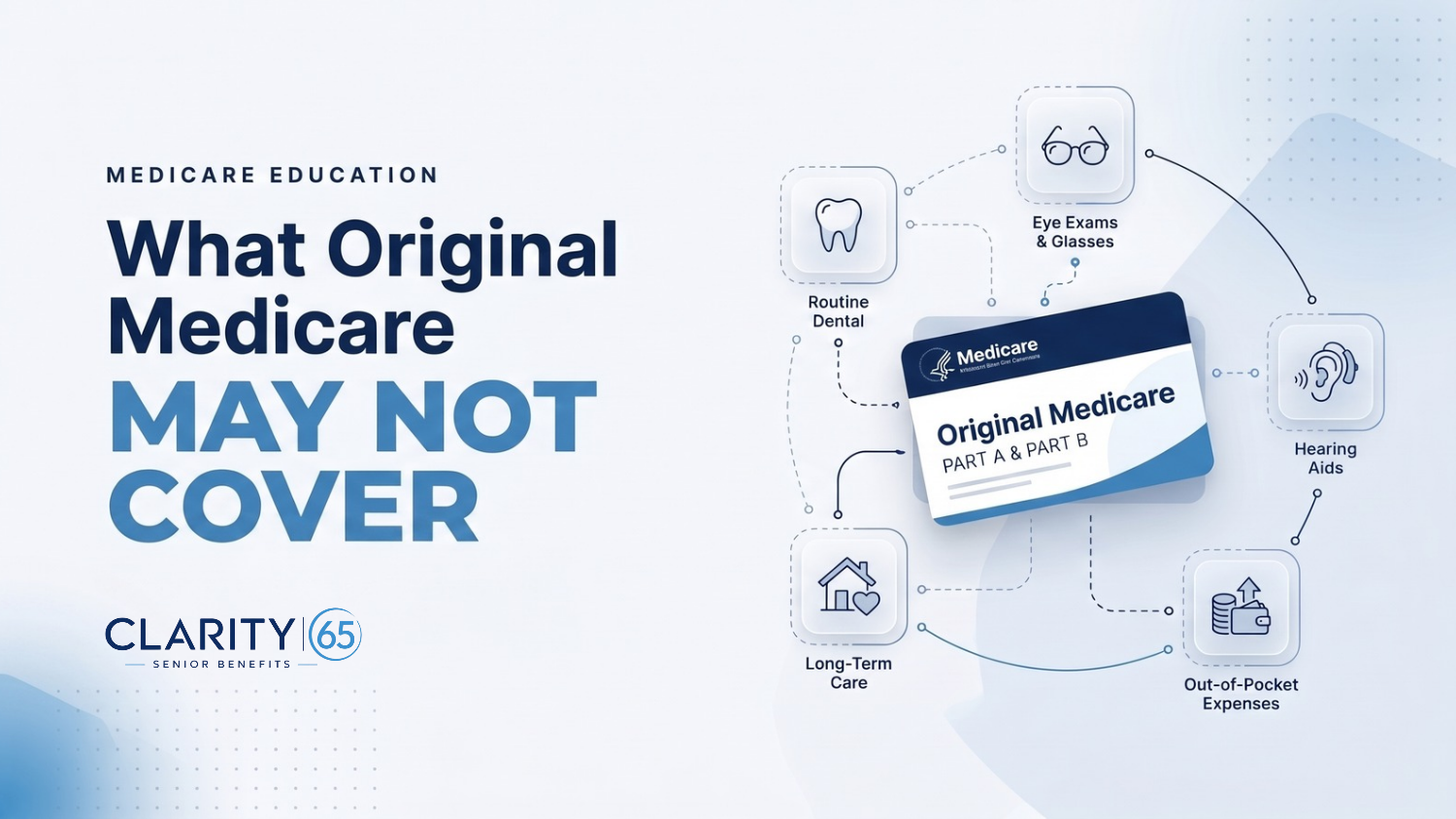
Many people assume Medicare will cover most of their healthcare expenses once they enroll. But what Original Medicare may not cover is just as important to understand as the services it does pay for.
Original Medicare includes Part A, which covers eligible inpatient hospital care and certain related services, and Part B, which covers eligible medical services, outpatient care, and preventive services. Even with both parts, some everyday healthcare expenses remain outside the program.
Routine dental care, prescription glasses, hearing aids, most outpatient prescription drugs, and non-medical long-term care are common examples. However, certain medical circumstances create exceptions, so it is important to check the details before assuming a service is excluded.
Understanding these gaps can help you plan for potential expenses, review additional coverage options, and avoid surprises when you need care.
In This Guide:
- AI Overview: What Does Original Medicare Not Cover?
- TL;DR: Common Services Original Medicare May Not Cover
- 1. Routine Dental Care
- 2. Routine Vision Exams and Prescription Glasses
- 3. Hearing Aids and Hearing Aid Fitting Exams
- 4. Long-Term Care and Help With Daily Activities
- 5. Most Outpatient Prescription Drugs
- 6. Cosmetic Surgery and Certain Elective Procedures
- 7. Routine Physical Exams and Services With Coverage Limits
- 8. Medical Care Outside the United States
- 9. Massage Therapy and Concierge Care Fees
- 10. Services From Providers Who Have Opted Out of Medicare
- How to Avoid Unexpected Medicare Bills
- What Can Help Cover Services Original Medicare Excludes?
- Original Medicare Coverage Checklist
- How Clarity65 Can Help You Understand Your Coverage Options
- Final Thoughts
- Frequently Asked Questions
AI Overview: What Does Original Medicare Not Cover?
Original Medicare generally does not cover routine dental care, eye exams for prescription glasses, hearing aids, exams for fitting hearing aids, non-medical long-term care, cosmetic surgery in most circumstances, routine physical exams, massage therapy, or most healthcare received outside the United States.
It also does not cover most outpatient prescription drugs through Parts A and B. People who want Medicare prescription drug coverage generally need a separate Part D plan unless they receive drug coverage through a Medicare Advantage plan.
Some exceptions apply. For example, Medicare may cover specific dental services connected to certain medical treatments, diagnostic hearing exams when medically necessary, and limited skilled nursing or home health care when eligibility requirements are met. (Medicare.gov: What's not covered)
TL;DR: Common Services Original Medicare May Not Cover
| Service or expense | What to know |
|---|---|
| Routine dental care | Cleanings, fillings, dentures, and most routine dental procedures generally are not covered |
| Routine vision care | Eye exams for glasses and regular prescription eyewear generally are not covered |
| Hearing aids | Hearing aids and exams for fitting them are not covered |
| Long-term custodial care | Help with everyday activities, such as bathing and dressing, generally is not covered |
| Most outpatient prescriptions | A separate Part D plan is generally needed for Medicare prescription drug coverage |
| Cosmetic procedures | Most procedures performed only to change appearance are not covered |
| Routine physical exams | A routine physical is not covered, although certain preventive visits and screenings are |
| International healthcare | Original Medicare generally does not cover medical care outside the United States |
| Massage therapy | Generally not covered, apart from any service that separately meets applicable Medicare coverage rules |
| Concierge care fees | Membership or retainer fees generally are not covered |
These exclusions are not absolute in every situation. Coverage depends on the service, medical circumstances, and applicable Medicare rules. (Medicare.gov)
1. Routine Dental Care
Dental expenses can catch people off guard after they enroll in Medicare.
Original Medicare generally does not cover routine dental services such as cleanings, fillings, tooth extractions, dentures, and most dental implants.
This means you may have to pay the full cost of routine treatment yourself unless you have other coverage that helps with these expenses.
Are Any Dental Services Covered?
Yes. Medicare may cover certain dental services when they are directly connected to specific covered medical treatments.
Examples include dental examinations and treatment required before certain heart valve procedures, organ transplants, or cancer treatments. Coverage depends on the medical circumstances and Medicare's requirements. (Medicare.gov: Dental services)
The important distinction is that Medicare does not automatically cover routine dental care just because your dentist considers it medically important.
Before scheduling expensive treatment, ask the dental provider whether the specific service may qualify for Medicare coverage and what you could owe.
What Can You Do About Dental Costs?
If you expect to need regular cleanings, fillings, dentures, or other dental work, consider whether separate dental coverage or a Medicare Advantage plan with dental benefits may be worth reviewing.
Benefits vary by plan. Check annual limits, covered procedures, provider requirements, waiting periods, and potential out-of-pocket costs before enrolling.
2. Routine Vision Exams and Prescription Glasses
Original Medicare generally does not cover routine eye exams for prescription glasses or contact lenses. It also does not usually pay for regular prescription eyewear.
However, Medicare can cover certain medically necessary eye services and screenings.
For example, eligible people may receive coverage for glaucoma screenings, and Part B covers certain diabetic retinopathy exams for people who meet the applicable requirements.
What About Glasses After Cataract Surgery?
There is an important exception.
After qualifying cataract surgery that implants an intraocular lens, Part B covers one pair of eyeglasses with standard frames or one set of contact lenses, subject to Medicare's rules and applicable costs. (Medicare.gov: Eye exams)
If you need regular glasses or an updated prescription, you should not assume Medicare will pay for them.
Check whether you have other vision coverage or whether an available Medicare Advantage plan offers a vision benefit that addresses your needs.
3. Hearing Aids and Hearing Aid Fitting Exams
Hearing difficulties can affect conversations, daily activities, and communication with family. But hearing aids are another expense Original Medicare generally does not cover.
Medicare does not cover hearing aids or exams specifically performed to fit hearing aids.
There is an important distinction between those services and diagnostic hearing exams.
Part B may cover diagnostic hearing and balance exams when a doctor or other qualified healthcare provider orders them to investigate a medical concern or determine whether treatment is needed. (Medicare.gov: Hearing and balance exams)
How Can You Prepare for Hearing Aid Expenses?
If you are considering hearing aids, ask the provider for a written estimate covering the devices, fitting, adjustments, and follow-up visits.
You can also review whether an available Medicare Advantage plan includes a hearing benefit.
Check which devices qualify, which providers you can use, and how much the plan may pay. An advertised allowance does not necessarily cover the full cost of hearing aids.
4. Long-Term Care and Help With Daily Activities
One of the largest potential gaps in Original Medicare is non-medical long-term care, sometimes called custodial care.
This type of care helps a person manage everyday activities, including:
- Bathing and personal hygiene
- Dressing
- Eating
- Using the bathroom
- Moving around safely
- Receiving help with ordinary daily tasks
Medicare generally does not pay for ongoing custodial care when that is the only care a person needs. This can include long-term assistance received at home, in an assisted living setting, or in a nursing home. (Medicare.gov: Long-term care)
Is Skilled Nursing Facility Care Also Excluded?
No. Skilled nursing facility care is different from long-term custodial care.
Medicare may cover limited skilled nursing facility care when a person meets the program's eligibility and coverage requirements. This can include requirements related to a qualifying inpatient hospital stay, the need for skilled services, and the facility.
That does not mean Medicare will pay for an indefinite nursing home stay.
The distinction is between qualifying skilled care and ongoing assistance with daily activities that does not require skilled services.
Why Should You Plan Ahead?
People sometimes assume Medicare will pay for all nursing home or in-home care if their health declines.
Because long-term custodial care is generally excluded, it is worth considering how you would handle these expenses if you needed ongoing help.
Depending on your circumstances, other resources or coverage may be relevant. Medicaid, for example, may cover certain long-term services and supports for people who meet its eligibility rules.
5. Most Outpatient Prescription Drugs
Original Medicare Parts A and B do not cover most prescription drugs you pick up at a retail pharmacy.
Part B does cover certain medications under specific circumstances, such as some drugs administered in a doctor's office or outpatient facility. But that is different from routine outpatient prescription coverage.
If you have Original Medicare and want coverage for most prescriptions, you generally need a separate Medicare Part D plan.
Part D plans have their own premiums, formularies, deductibles, pharmacy networks, and cost-sharing rules.
What Should You Check Before Choosing Drug Coverage?
Start with the medication list you actually use.
Check whether every prescription is covered by the plan's formulary, which is its list of covered drugs. Then review the drug tiers, cost-sharing, pharmacy options, and any restrictions that apply.
A plan with a low monthly premium may not necessarily have the lowest total cost for your prescriptions.
For more detail, read the Clarity65 guide to Medicare Part D.
6. Cosmetic Surgery and Certain Elective Procedures
Original Medicare generally does not cover cosmetic surgery when the main purpose is to change a person's appearance rather than treat a medical condition.
For example, a procedure performed solely to alter appearance is usually not covered.
There are exceptions. Medicare may cover certain procedures when they are medically necessary, address a functional problem, or meet specific coverage requirements. Breast reconstruction after a mastectomy for breast cancer is one example. (Medicare.gov: Cosmetic surgery)
The important point is that the name of a procedure alone may not determine coverage. The reason for the procedure and the applicable Medicare rules matter.
Before proceeding, ask the provider whether Medicare is expected to cover the service, whether additional documentation or approval is needed, and what costs you may be responsible for if coverage is denied.
7. Routine Physical Exams and Services With Coverage Limits
Original Medicare covers many preventive services and screenings, but it does not cover every type of appointment.
For example, a routine physical examination is generally not covered.
That does not mean Medicare provides no preventive care. Eligible beneficiaries can receive the “Welcome to Medicare” preventive visit and yearly Medicare wellness visits, along with specific preventive screenings and services that meet Medicare's requirements.
These visits are not the same as a traditional head-to-toe physical examination. Additional services performed during an appointment may have separate coverage and cost-sharing rules.
What If Medicare Covers a Service Only Under Certain Conditions?
Medicare coverage can depend on medical necessity, how often a service is provided, and whether specific eligibility requirements are met.
A test or treatment may be covered for one medical reason but not for another. A service may also be covered only at certain intervals.
Before undergoing a recommended procedure, ask the provider:
- Why is this service being recommended?
- Does Medicare cover it for my medical situation?
- Are there frequency limits?
- Could I owe the full cost if Medicare does not cover it?
Medicare's official coverage information can help you check a specific service before you receive it.
8. Medical Care Outside the United States
Original Medicare generally does not cover healthcare when you travel outside the United States.
There are limited exceptions, including certain emergencies involving a foreign hospital that is closer than an appropriate U.S. hospital under specific circumstances. These exceptions are narrow, so travelers should not assume that Medicare will pay for an overseas hospital visit. (Medicare.gov: Travel outside the U.S.)
Can Additional Coverage Help?
Some Medicare Supplement Insurance policies, also called Medigap, cover certain foreign travel emergency expenses. The benefit depends on the policy and its limits.
Travel medical insurance may also be worth investigating for international trips. Read the exclusions, limits, and conditions carefully because travel insurance does not always include comprehensive medical coverage.
If you travel frequently, check your coverage before leaving home rather than waiting until an emergency occurs.
9. Massage Therapy and Concierge Care Fees
Original Medicare generally does not cover massage therapy.
It also generally does not cover membership or retainer fees charged by concierge medical practices. These fees may pay for access to a doctor, longer appointments, or other membership services rather than a Medicare-covered medical service.
If you are considering a concierge practice, ask how its billing works and whether it accepts Medicare for covered services. A membership fee and a medical service are not necessarily treated the same way.
Do not assume that Medicare will reimburse you for a payment simply because the provider is a physician.
10. Services From Providers Who Have Opted Out of Medicare
Another important exclusion involves providers who have formally opted out of Medicare.
In general, Original Medicare does not pay for covered services provided under a private contract by a provider who has opted out, except in emergencies or situations involving urgent needs under the applicable rules.
This is different from seeing a doctor who accepts Medicare but does not accept assignment. Providers who have opted out operate under different rules.
Before receiving care from a provider who does not participate in Medicare, ask whether they have opted out, whether you will be asked to sign a private contract, and what you will owe.
How to Avoid Unexpected Medicare Bills
Knowing what Original Medicare excludes is useful, but it is equally important to check coverage before receiving a service.
Use this checklist when a doctor recommends a test, treatment, or item:
| What to check | Why it matters |
|---|---|
| Medicare coverage | The service may be excluded or covered only in certain circumstances |
| Medical necessity | Coverage may depend on your diagnosis and reason for treatment |
| Frequency limits | Medicare may cover a service only at certain intervals |
| Provider status | A provider's participation in Medicare can affect payment |
| Other insurance | Medigap, employer coverage, Medicaid, or other insurance may help with eligible costs |
| Written estimate | Helps you understand potential expenses before treatment |
| Medicare notice | If applicable, an Advance Beneficiary Notice can explain that a service may not be covered |
If a provider expects Medicare to deny a service that would otherwise be covered, you may receive an Advance Beneficiary Notice of Noncoverage (ABN) in applicable situations. Read it carefully before signing so you understand the potential financial responsibility.
If Medicare denies a claim and you believe the service should have been covered, review the explanation on your Medicare Summary Notice and follow the appeal instructions when appropriate.
What Can Help Cover Services Original Medicare Excludes?
You have several options to investigate, depending on your needs and eligibility.
Medicare Advantage
Medicare Advantage is another way to receive Medicare Part A and Part B benefits through a Medicare-approved private plan.
Some plans may offer extra benefits that Original Medicare generally does not cover, such as certain dental, vision, hearing, or fitness benefits. The services, limits, costs, and eligibility requirements vary by plan.
Read the Clarity65 Medicare Advantage guide to understand how these plans work.
Medicare Supplement Insurance
Medicare Supplement Insurance, or Medigap, works alongside Original Medicare to help pay certain cost-sharing expenses, such as eligible deductibles, coinsurance, and copayments.
However, Medigap generally does not cover services Original Medicare excludes, such as routine dental care, hearing aids, or long-term custodial care.
Learn more in the Clarity65 Medicare Supplement guide.
Separate Coverage and Assistance Programs
Depending on your circumstances, separate dental, vision, or hearing insurance may help cover certain expenses.
People who qualify may also be eligible for Medicaid or other assistance programs that help pay healthcare costs or provide services Medicare does not generally cover. Each program has its own eligibility rules.
The right approach is to identify the expense you need help with, then check which coverage or assistance options actually apply.
Original Medicare Coverage Checklist
Before an appointment or procedure, take a few minutes to ask:
- Is the service covered by Part A or Part B?
- Is it covered for my specific medical condition?
- Does Medicare have frequency or eligibility requirements?
- Will I need a referral, order, or other documentation?
- Does my provider participate in Medicare?
- Could I be responsible for the full cost?
- Does other insurance help pay for the service?
- Have I received and understood any notice about possible noncoverage?
Keep the answers with your healthcare paperwork so you can refer to them when planning future care.
How Clarity65 Can Help You Understand Your Coverage Options
Understanding exclusions is an important part of understanding Medicare as a whole. It can help you identify where you may need to budget for care, investigate additional coverage, or ask more detailed questions before enrolling.
Clarity65 works with independent licensed agents who can explain available Medicare coverage options and review factors such as costs, providers, prescriptions, and plan benefits. Clarity65 represents multiple Medicare carriers and offers annual plan reviews.
You can start with Understanding Your Medicare Coverage Options or explore the New to Medicare guide.
Clarity65's service is free to consumers. Keep in mind that Clarity65 does not offer every plan available in every area, and information from its agents is limited to the plans it offers in your area.
Final Thoughts
Understanding what Original Medicare may not cover can help you prepare for expenses that fall outside Part A and Part B. Routine dental services, prescription eyewear, hearing aids, most outpatient prescriptions, long-term custodial care, and medical treatment outside the United States are common examples.
But exclusions do have exceptions. Medicare may cover certain dental procedures tied to specific medical treatments, diagnostic hearing exams, qualifying skilled nursing care, and certain preventive services. The reason for the service and the applicable rules matter.
Before receiving care, verify coverage, ask about potential charges, and check whether other coverage may help. If a service is denied, review the explanation and appeal process rather than assuming the decision cannot be challenged.
The more you understand what Medicare covers and where gaps may exist, the better prepared you can be to plan your healthcare expenses and review your coverage options.
Frequently Asked Questions
What services does Original Medicare generally not cover?
Original Medicare generally excludes routine dental care, eye exams for glasses, hearing aids, non-medical long-term care, most outpatient prescription drugs, cosmetic surgery, and most medical care outside the United States. Exceptions may apply to certain services and medical circumstances.
Does Original Medicare cover dental implants or dentures?
Generally, no. Most routine dental procedures, dentures, and implants are not covered. Medicare may cover specific dental services directly connected to certain covered medical treatments when its requirements are met.
Does Original Medicare cover hearing aids?
No. Original Medicare does not cover hearing aids or exams for fitting them. Part B may cover diagnostic hearing and balance exams when a healthcare provider orders them to investigate a medical concern.
Does Medigap pay for services Original Medicare does not cover?
Generally, no. Medigap helps pay certain cost-sharing expenses associated with covered Original Medicare services. It does not generally add coverage for routine dental care, hearing aids, or long-term custodial care.
Can Medicare Advantage cover services that Original Medicare does not?
Some Medicare Advantage plans offer additional benefits, including certain dental, vision, and hearing services. Coverage and limits vary by plan, so review the specific benefits and costs before enrolling.
Raul Gonzalez
Licensed AgentIndependent licensed Medicare advisor dedicated to plain-English guidance and personalized plan comparisons across leading national carriers.
Clarity65 is not connected with or endorsed by the U.S. government or the federal Medicare program.