
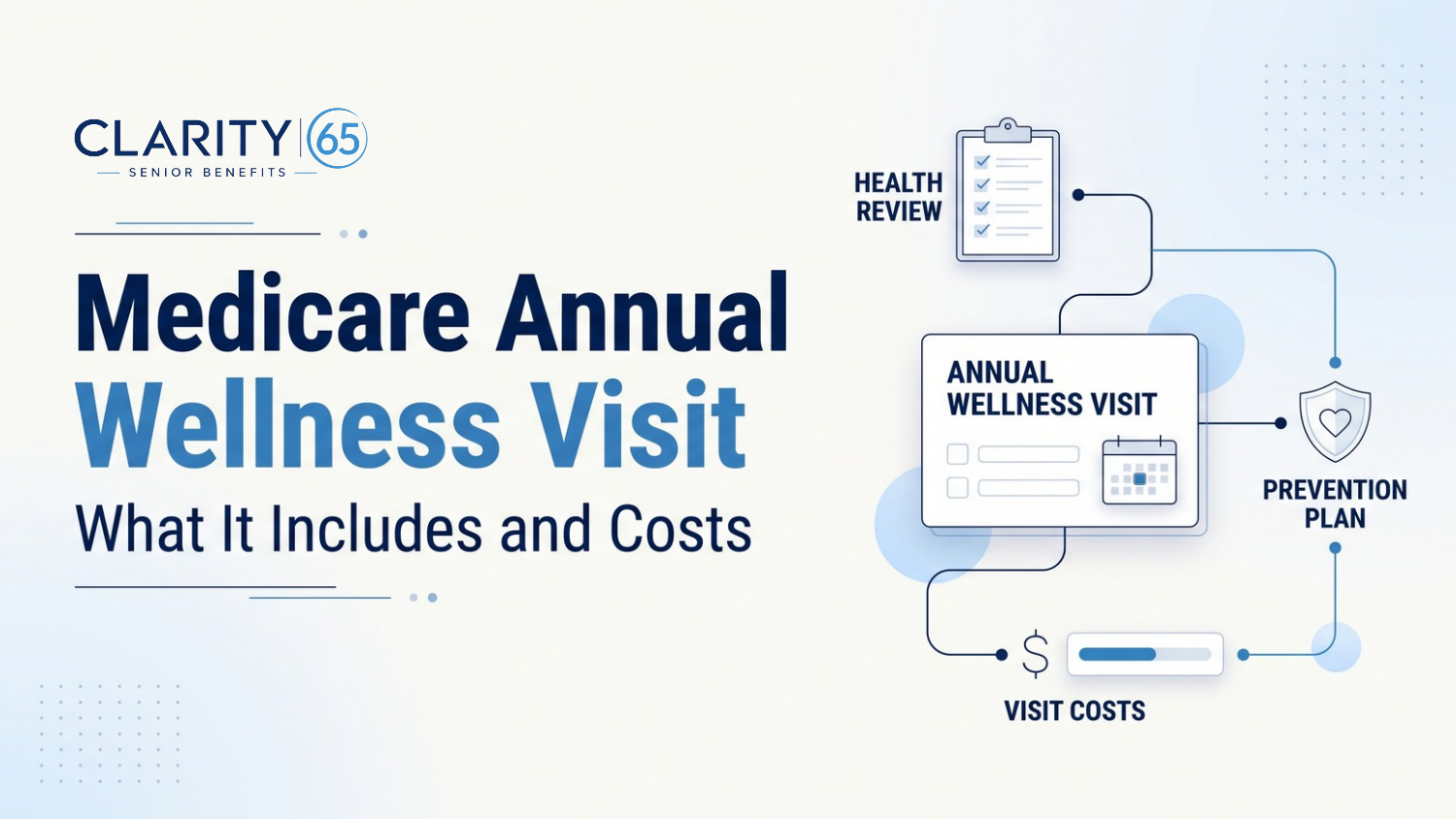
Many people think Medicare covers a yearly physical exam automatically. In reality, Medicare has a specific preventive appointment called the Medicare Annual Wellness Visit, and it works differently from a traditional physical.
This visit gives you and your healthcare provider an opportunity to review your health history, identify potential health risks, assess certain aspects of your well-being, and create or update a plan for preventive care.
Medicare Part B covers this visit for eligible beneficiaries once every 12 months, provided the applicable requirements are met. If your doctor accepts Medicare assignment, you generally pay nothing for the covered wellness visit itself. However, additional services provided during the appointment may involve separate costs.
Understanding what the visit includes, when you qualify, and how to prepare can help you make better use of this Medicare benefit.
In This Guide:
- What Is the Medicare Annual Wellness Visit?
- TL;DR: What to Know About Your Medicare Wellness Visit
- What Is Included in a Medicare Annual Wellness Visit?
- Medicare Annual Wellness Visit vs. a Routine Physical
- Welcome to Medicare Visit vs. Annual Wellness Visit
- Does Medicare Cover the Annual Wellness Visit at No Cost?
- Who Is Eligible for a Medicare Annual Wellness Visit?
- How to Prepare for Your Annual Wellness Visit
- What Happens After the Wellness Visit?
- Is the Annual Wellness Visit Worth Scheduling?
- How Clarity65 Can Help You Understand Medicare Coverage
- Final Thoughts
- Frequently Asked Questions
What Is the Medicare Annual Wellness Visit?
The Medicare Annual Wellness Visit is a preventive appointment covered by Medicare Part B. Its purpose is to help identify health risks and establish or update a plan for preventive care based on your health history and current needs.
The visit generally includes a health risk assessment, a review of your medical and family history, an updated list of your healthcare providers and medications, routine measurements, cognitive impairment screening, and a recommended schedule for preventive services. Other assessments and discussions may also be included, depending on your situation.
The Annual Wellness Visit is not a comprehensive physical examination. Eligible beneficiaries can generally receive it once every 12 months, and there is no Part B deductible or coinsurance for the covered visit when the provider accepts assignment. Additional tests or services may result in separate charges.
TL;DR: What to Know About Your Medicare Wellness Visit
| Question | Answer |
|---|---|
| What is it? | A preventive visit to review health risks and plan future preventive care |
| Which part covers it? | Medicare Part B |
| How often can you get it? | Once every 12 months |
| Who qualifies? | Generally, people with Part B for more than 12 months who meet the visit's timing requirements |
| Is it a physical exam? | No |
| Does it cost anything? | Generally $0 for the covered visit if the provider accepts assignment |
| Are additional tests included? | Not necessarily. Separate tests or services may cost extra |
| What should you bring? | Medication list, medical history, family history, and provider information |
What Is Included in a Medicare Annual Wellness Visit?
The visit focuses on prevention rather than providing a complete physical examination.
Your healthcare provider reviews information about your health, identifies relevant risks, and uses that information to establish or update your preventive care plan.
Here are the main components included in the appointment:
1. Health Risk Assessment
You will generally complete a questionnaire called a Health Risk Assessment.
It helps your provider understand your current health, daily habits, and potential risk factors.
Questions may cover physical activity, nutrition, tobacco and alcohol use, emotional well-being, pain, fatigue, social circumstances, and your ability to manage daily activities.
You may also be asked about safety at home, previous falls, and difficulties with everyday tasks.
Answer these questions honestly. The purpose is to help identify areas where further discussion, education, or preventive services may be useful.
2. Review of Your Medical and Family History
Your provider will review your medical history and relevant family health information.
This can include previous illnesses, surgeries, hospital stays, allergies, treatments, and health conditions that run in your family.
Family history can be important because some conditions have hereditary risk factors.
Before the appointment, make a note of significant illnesses affecting your parents, siblings, and children, when that information is available.
You should also mention major health changes since your previous wellness visit.
3. Review of Medications and Healthcare Providers
Your medication list is another important part of the appointment.
Bring a current list of prescription medications, over-the-counter medicines, vitamins, and supplements. Include how often you take each one and the dosage when possible.
Your provider can review this information and update the record of medications you use.
The visit also includes reviewing your current healthcare providers and suppliers. This can help keep your medical records organized, particularly if you see multiple specialists or receive care from several facilities.
If you have started seeing a new doctor or specialist, bring their contact information.
4. Routine Measurements
The wellness visit may include measurements such as height, weight, blood pressure, and body mass index (BMI), as appropriate.
These measurements can help your provider review potential health risks and determine whether further evaluation or preventive care may be useful.
They do not automatically mean that you will receive a complete physical examination or every diagnostic test that might be recommended at a regular medical appointment.
5. Cognitive Assessment
Medicare includes a cognitive assessment during the Annual Wellness Visit.
Your provider looks for signs of cognitive impairment, which can involve difficulties with memory, learning, concentration, or decision-making.
This does not mean that everyone attending a wellness visit will receive a diagnosis of dementia.
If there are concerns, Medicare covers a separate, more comprehensive cognitive evaluation when applicable requirements are met. That evaluation can help assess conditions such as dementia, depression, anxiety, or delirium.
If you or a family member have noticed changes in memory or thinking, mention those concerns during the appointment.
6. Review of Mental Health and Substance Use Risks
The wellness visit can include a review of risk factors associated with mental health and substance use.
Your provider may ask about alcohol or tobacco use, and other relevant risk factors. If you use opioid medication, your provider will review potential risks related to opioid use disorder, assess your pain and current treatment, and discuss non-opioid treatment options when appropriate.
Referrals may be recommended when further evaluation or treatment is needed.
These conversations are part of reviewing your overall health and identifying concerns that may deserve attention.
7. A Preventive Screening Schedule
One of the most useful parts of the appointment is the recommended screening schedule.
Based on your age, health history, risk factors, and previous screenings, your provider can prepare or update a checklist of preventive services that may be appropriate over the next several years.
This may include recommendations about eligible cancer screenings, vaccines, cardiovascular health, diabetes screening, and other preventive services.
The wellness visit does not mean every screening will take place that day. Some may need separate appointments, and coverage requirements can vary by service.
Ask which screenings are due, which ones Medicare covers, and whether you need to schedule them separately.
8. Health Advice and Referrals
Your provider may offer health advice or refer you to preventive education and support services.
Depending on your needs, the discussion may cover physical activity, nutrition, tobacco cessation, fall prevention, weight management, or other health risks.
If an assessment identifies an issue that needs attention, your provider may recommend a separate appointment or referral.
The goal is to give you a clearer plan for maintaining your health and addressing risks before they become more serious.
9. Optional Advance Care Planning
You may also choose to discuss advance care planning during the wellness visit.
Advance care planning involves thinking about and documenting your preferences for future medical care in case you become unable to communicate or make healthcare decisions.
Your provider can explain advance directives and discuss how you might document your wishes.
This conversation is optional. You can ask questions and decide whether you want to take further steps.
10. Optional Physical Activity and Nutrition Risk Assessment
Medicare includes an optional Physical Activity and Nutrition Risk Assessment as part of the Annual Wellness Visit.
For 2026, CMS updated the description of the optional assessment associated with HCPCS code G0136. It was previously described as a Social Determinants of Health Risk Assessment and is now designated as a Physical Activity and Nutrition Risk Assessment.
This assessment helps your healthcare provider understand your physical activity habits and nutritional patterns, including how they may affect your health. The information can guide preventive advice, care decisions, or referrals to appropriate services and support.
Your provider may ask questions about your activity levels and eating habits using a standardized, evidence-based assessment. The purpose is to identify potential risks and discuss steps that may support your health.
The assessment is optional, so it may not be included in every Annual Wellness Visit. You can ask your provider whether it is appropriate for you and what it will involve.
Medicare Part B generally covers this assessment at no cost when it is provided as part of your yearly Wellness Visit and applicable coverage requirements are met. If it is provided during a different type of office or behavioral health visit, cost-sharing may apply.
Medicare Annual Wellness Visit vs. a Routine Physical
This is one of the most common sources of confusion for Medicare beneficiaries.
Although both appointments involve your health, they serve different purposes.
| Feature | Annual Wellness Visit | Routine Physical Exam |
|---|---|---|
| Main purpose | Review health risks and plan preventive care | Examine your physical health |
| Medical history review | Included | May be included |
| Health Risk Assessment | Included | Not a standard requirement |
| Preventive screening schedule | Included | Not a defining feature |
| Comprehensive physical examination | Not included as a required component | May include one |
| Medicare coverage | Covered under Part B when eligibility requirements are met | Generally not covered as a routine physical |
| Potential cost | Generally $0 for the covered visit if the provider accepts assignment | You may pay the full cost if Medicare does not cover the service |
An Annual Wellness Visit is not a substitute for an appointment to evaluate symptoms or address a specific medical problem.
For example, if you have new chest discomfort, persistent pain, or another concerning symptom, schedule a medical appointment to discuss it rather than relying on the wellness visit alone.
Likewise, if you want a comprehensive physical examination, ask your provider whether Medicare covers the proposed services and what you may owe.
What Is the Difference Between the Welcome to Medicare Visit and the Annual Wellness Visit?
Medicare offers two different preventive visits that are easy to confuse.
The Welcome to Medicare preventive visit is a one-time appointment available during the first 12 months you have Part B.
The Annual Wellness Visit becomes available later, subject to the required timing rules, and can generally be repeated once every 12 months.
| Feature | Welcome to Medicare Visit | Annual Wellness Visit |
|---|---|---|
| When it is available | Within the first 12 months of Part B | After the applicable 12-month waiting period |
| How often | One time | Once every 12 months |
| Main purpose | Review medical and social history, preventive services, and health risks | Review health risks and establish or update a preventive care plan |
| Physical exam | Not a comprehensive physical exam | Not a comprehensive physical exam |
| Cost | Generally $0 if the provider accepts assignment | Generally $0 for the covered visit if the provider accepts assignment |
You do not have to receive the Welcome to Medicare visit to qualify for a later Annual Wellness Visit. However, your first Annual Wellness Visit cannot occur within 12 months of enrolling in Part B or within 12 months of your Welcome to Medicare preventive visit.
If you are unsure which visit you have already received, ask your healthcare provider's office to check your records.
Does Medicare Cover the Annual Wellness Visit at No Cost?
For eligible beneficiaries, Medicare Part B covers the Annual Wellness Visit without a Part B deductible or coinsurance when the provider accepts assignment.
However, a $0 covered wellness visit does not mean every service performed during the same appointment will also be free.
Suppose you attend a wellness visit and mention a new medical concern. Your provider may evaluate that concern as a separate service.
Or your provider may order a test that is not included in the preventive visit benefit.
In those situations, a separate charge may apply, depending on the service, coverage rules, and how it is billed. If Medicare does not cover an additional service, you could be responsible for its full cost.
Before receiving an additional test or service, ask whether it is part of the covered wellness visit or will be billed separately.
This simple question can help you understand your potential costs before the appointment is over.
Who Is Eligible for a Medicare Annual Wellness Visit?
You generally need to have Medicare Part B for longer than 12 months to qualify.
You must also meet the timing requirements for the first wellness visit. Your first Annual Wellness Visit cannot take place within 12 months of the start of Part B or within 12 months of your Welcome to Medicare preventive visit.
Afterward, Medicare generally covers a wellness visit once every 12 months.
For example, someone who started Part B more than 12 months ago and has not received a wellness visit during the preceding 12 months may be eligible, assuming the other requirements are met.
If you have a Medicare Advantage plan, check with the plan or provider about how to schedule the covered visit and which providers are available through the plan.
If you are uncertain about your eligibility, your healthcare provider's office can help verify when you last received a qualifying visit.
How to Prepare for Your Annual Wellness Visit
You do not need to arrive with every detail of your medical history memorized.
A little preparation can make the appointment more useful.
Bring These Items
Before your visit, gather:
- Your Medicare card or current plan information
- A list of prescription medications
- A list of over-the-counter medicines, vitamins, and supplements
- Your family health history
- Information about previous illnesses and surgeries
- Immunization records, if available
- Names of your doctors and other healthcare providers
- Questions about preventive screenings
- Concerns about memory, falls, mobility, or daily activities
If a family member helps manage your care, you may want to ask the provider whether that person can join the discussion.
You can also complete any Health Risk Assessment questionnaire the provider sends before the appointment.
Questions Worth Asking
Use the visit to clarify your next steps. You might ask:
- Which preventive screenings am I due for?
- Which vaccines should I discuss with my provider?
- Do my health history or family history suggest any additional risks?
- Should I have my memory or balance evaluated further?
- Are there services that Medicare may cover for my health needs?
- Will any recommended tests involve additional costs?
- When should I schedule my next wellness visit?
Write down the answers or ask for a copy of your screening schedule.
What Happens After the Wellness Visit?
After the appointment, review the recommendations your provider gives you.
You may receive a list of recommended screenings, referrals, or steps to address certain health risks.
Some recommendations can be handled during a later appointment. Others may involve a specialist, a laboratory, or another healthcare provider.
Keep the plan with your medical records and note any appointments you need to schedule.
Remember that the wellness visit is primarily preventive. If you have symptoms or a condition that needs treatment, follow up with your provider about the appropriate clinical appointment.
Is the Annual Wellness Visit Worth Scheduling?
For eligible beneficiaries, the visit offers an opportunity to review health risks and get organized around preventive care.
It can help you identify screenings that may be due, update your medication and provider information, discuss concerns about memory or fall risks, and establish a schedule for future preventive services.
It can be particularly useful if you have several doctors, manage ongoing health conditions, or have not reviewed your preventive care needs recently.
The visit will not eliminate every health risk, and it does not replace treatment for existing medical problems. But it can help you and your provider identify areas that deserve attention.
How Clarity65 Can Help You Understand Medicare Coverage
The Annual Wellness Visit is a Medicare preventive benefit, but other healthcare services can have different eligibility rules and costs.
Clarity65 works with independent licensed agents who explain available Medicare coverage options and review factors such as premiums, provider networks, prescription coverage, and plan benefits.
Clarity65 represents multiple Medicare carriers and offers annual plan reviews. Its service is free to consumers.
If you are new to Medicare, start with the Clarity65 New to Medicare guide. You can also read Understanding Your Medicare Coverage Options to learn how Original Medicare, Medicare Advantage, Medigap, and prescription drug coverage differ.
For questions about the Annual Wellness Visit itself, contact your healthcare provider or Medicare directly. Clarity65 can help explain insurance coverage options, but medical screening and treatment decisions belong with your healthcare professional.
Final Thoughts
The Medicare Annual Wellness Visit is an opportunity to review your health risks, update important medical information, and establish a schedule for preventive care.
It includes a Health Risk Assessment, medical and family history review, medication and provider information, routine measurements, cognitive assessment, and recommendations for preventive services. Depending on your circumstances, it may also include discussions about health risks, advance care planning, and social needs.
The visit is not a comprehensive physical examination, and additional tests or services may involve separate costs. Knowing that distinction can help you prepare and avoid unexpected bills.
Check your eligibility, bring the right information, and ask your provider which screenings and follow-up appointments you may need. A little preparation can help you get more value from this Medicare benefit.
Frequently Asked Questions
Is the Medicare Annual Wellness Visit the same as a physical?
No. The Annual Wellness Visit focuses on health risks, medical history, and preventive care planning. It is not a comprehensive physical examination. A routine physical may involve different services and costs.
How often does Medicare pay for an Annual Wellness Visit?
Medicare generally covers the Annual Wellness Visit once every 12 months if you meet the eligibility requirements. Your first visit must follow the required waiting period after Part B begins and cannot occur within 12 months of your Welcome to Medicare visit.
Do I have to pay for my Medicare wellness visit?
You generally pay nothing for the covered Annual Wellness Visit when your provider accepts assignment. However, additional tests or services performed during the same appointment may have separate charges.
Do I need to have a Welcome to Medicare visit first?
No. You do not have to receive the Welcome to Medicare preventive visit to qualify for an Annual Wellness Visit. However, the applicable 12-month timing requirements still apply.
What should I bring to my Annual Wellness Visit?
Bring your prescription and supplement list, medical and family history, immunization records if available, and information about your current healthcare providers. Prepare questions about preventive screenings, memory, balance, and any follow-up care you may need.
Sources for further reading
This article is for general educational purposes and does not substitute for professional medical advice, diagnosis, or treatment. Coverage rules and preventive service schedules can vary based on individual medical history and provider billing practices. Always consult your healthcare provider regarding personal health questions and recommended screenings.
Raul Gonzalez
Licensed AgentIndependent licensed Medicare advisor dedicated to plain-English guidance and personalized plan comparisons across leading national carriers.
Clarity65 is not connected with or endorsed by the U.S. government or the federal Medicare program.